Archived Postings
●
Equestrians
Help ●
Position Statement ●
Thanks Forrestal
Committee ● PVPLC
Newsletter ●
Sierra Club
trail recommendations ●
CORBA booth at PV Street
Fair ● Forrestal
Public Meeting ●
National Trail Day
●
Trail Use Survey
●
Forrestal History
●
Plant Alert ● Bikes
Banned ●
Trail work December 10 2005
●
Meeting with Horsemen's Assoc
●
● Public Use Workshop
June 3rd 2006 ● Trail
workday 7-8-06
Public Use Workshop
June 3rd
We made a
difference. Keep it going!
The Palos Verdes Vision Plan and
Public Use Master Plan Visioning Workshop was held on June 3rd.
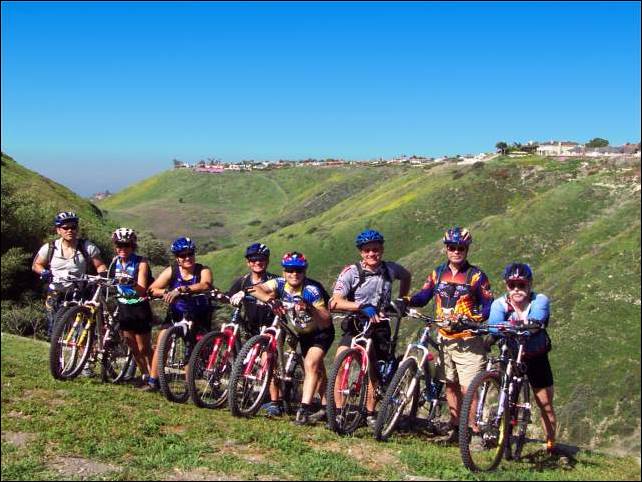
About 100 people attended the event. Over 22 cyclists made the
commitment to save our trails - thank you!
After an orientation by Melendrez and Associates, 8 workgroups of
about 10 people were formed to express views about open space. Their
conclusions were then presented to the assembly.
The results will be formally published later but some commons points
were expressed:
►
Keep the trails the same, without over sanitizing them.
►
Keep the trail use the same.
►
Create a fun zone for cyclists.
Some well-known ardent anti-bike people were in attendance but their
negative views were not part of the group conclusions. Why?
Because cyclists were there to express their views, face to face.
This is an example of what we have to do to keep our trails. Without
a helmet or body armor, cyclists are just good people with the same
rights as everyone else.
CORBA PV has worked hard to help keep trails open to bikes.
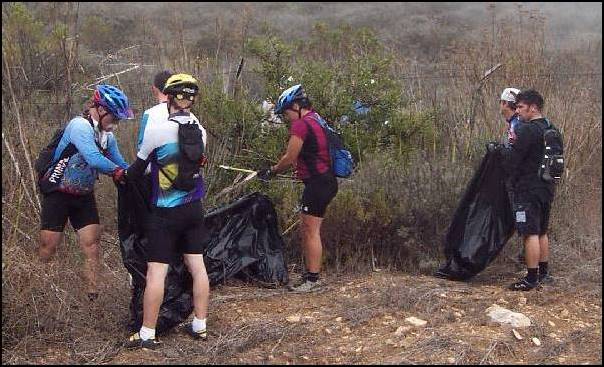
Cyclists have contributed hundreds of volunteer hours to help the
land conservancy and city repair trails. Because of the work
cyclists have done, most of the community is not opposed to bikes on
trails. However, there are some who take every opportunity to
fervently voice opposition to bikes. Without your participation,
they will succeed. Don’t let this happen!
Position:
For decades, hikers, equestrians, and cyclists have freely
shared trails on privately owned open space in Rancho Palos Verdes.
Cyclists have wholeheartedly supported the acquisition of open space
through fund raising and volunteerism. We are all stakeholders.
Every trail user has a fundamental right to use our communally owned
open space and trails. To deny this basic right should be the option
of last resort, pursued only after every effort has been made to
resolve perceived issues.
In the event land managers close trails to specific users, the
underlying reason should be clearly stated to allow for future
mitigation. Trails should not be segregated without measurable
cause.
Remediation should be given high priority with the intent to restore
trail access to everyone. This process should be reviewed on a
regular basis and be open to the public.
Issues:
Trail erosion – All trail users denude the tread surface.
However, water is the predominate cause of erosion on poorly
configured trails. Water erosion can be managed by trail work
projects that correct trail deficiencies. Cyclists have volunteered
hundreds of hours to repair and redirect water flow off trails.
Impact to habitat - There is no evidence that cyclists impact
habitat more than other trail users if they ride only on designated
trails. New trail construction can damage habitat. Cyclists have
organized to stop unauthorized trail building and to repair
inappropriate trails built before open space came under public
management. CORBA PV will continue to educate cyclists about this
important issue.
User conflict - Some trail users have complained about speeding
cyclists. We believe that this is a rare occurrence. To minimize
this issue, CORBA PV has created a trail brochure and web site to
educate cyclists about trail etiquette. In addition, CORBA PV has
offered to provide an on-trail presence to further educate trail
users and assist land managers and the city.
|
|
Palos Verdes
Peninsula Horsemen's Association Meeting
By Troy Braswell
I was invited to attend a meeting of the PVPHA on August 18 at the
Empty Saddle Club in Rolling Hills. PVPHA President Dale Allen
introduced me as a CORBA member, and I received a warm welcome. He
gave a brief history of our cooperation with their group at Forrestal.
I feel the exposure was a very positive step toward our goal of close
cooperation between cyclists and equestrians.
Guest lecturer Rod Bergen spoke to more than 50 horsemen about how to
deal with trail distractions, including bicycles. His focus was
directed at training the horse and rider to deal with any event that
may "spook" a horse.
Rod was not only informative but very entertaining as well. He
presented a lot of details about how horses perceive everything around
them and why they react to threats.
Horses have survived for thousands of years by instinctively running
away from anything that they see as a threat. Armed with the right
knowledge, equestrians can observe this behavior and react to prevent
disaster. A raised head with ears pointed forward is a key sign that
the horse is getting ready to escape the situation. A lowered head
means the horse is relaxed.
Equestrians were shown how to respond to this distressed state by
controlling the horse and understanding the horse’s needs for safety.
I participated by moving a bike towards a horse at progressively
higher speeds. Please note that this was not a simulation of a
high-speed bike encounter but was intended to show that the horse
could learn that I was not a threat. In the hands of Mr. Bergen, the
horse learned quickly and was well behaved.
While the focus was on horse/equestrian response, it is very obvious
that cyclists need to obey the rules of the trail and anticipate
encounters with any trail user. Here are some guidelines you’ve seen
before with some new insight on horse behavior.
● Maintain a speed that will allow you to stop well before an
encounter. If you can’t see around a curve or obstruction, slow down
as though there will be a horse or hiker there. Think ahead. Trail
bells are encouraged but are not a permit to go charging around blind
corners.
● If you see a horse, stop first. Don’t just slow down. Ask the rider
in a normal tone what to do.
● If the horse is approaching, get off the trail with everyone on the
same side. Don’t make the horse run a gauntlet. If there’s a drop off,
move to the downhill side so the horse is above you. Predators often
attack horses from above.
● If the horse becomes distressed, ask the rider what you should do.
Remember the horse must quickly find a “safe zone” in order to calm
down. Never surround a horse. Always leave an escape route.
● When the horse passes, don’t immediately jump on your bike or make
noise. Predators attack horses from the rear, so you may spook the
horse even after an otherwise good encounter.
● You are encouraged to stop and talk to the rider. Everyone benefits
from being a friendly member of the trail family.
● If you are tempted to pet the horse, ask the rider first and
approach with your hands down. If you touch the horse, extend your
hand palm down to reduce the threat response. Many horses don’t like
to be petted on the face, preferring the neck or shoulder instead. As
with many animals, eye contact can be viewed as a threat so don’t look
directly at the eyes. Stay visible at all times.
Every off-road cyclist is a representative for our sport. We
have to demonstrate these simple rules to every rider on every ride.
We have a great opportunity to form a lasting relationship with our
equestrian friends and to show everyone that we can all share the
trails in Rancho Palos Verdes.
|
Bikes Banned from Trails - Not Exactly
|
The RPV City Council
voted on the the trail access portion of the Forrestal Nature
Preserve Management Plan on Dec. 4.
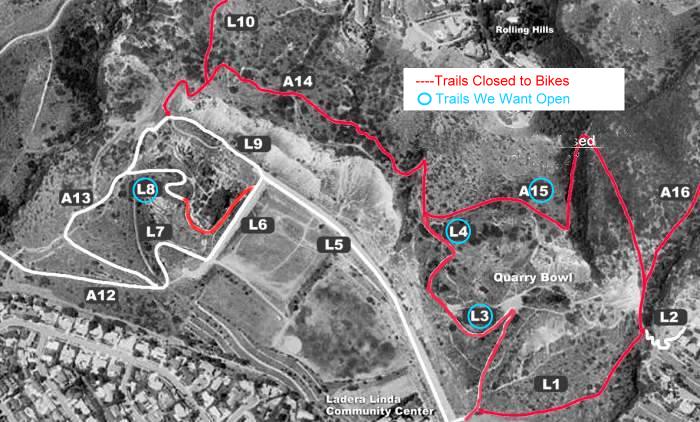
Bikes are temporarily restricted from trails A-14, A-15,
A-16, and L-1 because of safety and stability (map).
As soon as a revised map is available, we'll post it on this website
so you can understand exactly what trails are involved.
Here is the city statement.
At first, we were disappointed the council did not adopt the
Forrestal Steering Committee Management Plan as proposed, but we
realize the council’s approval of any mountain bike use in the
preserve is a success for our efforts. Remember that bicycle use was
not even considered before we became involved.
The city council’s vote was premised on putting a high priority on
improvements to the upper trails. CORBA-PV will focus our efforts on
getting these improvements started as soon as possible. We hope you
will volunteer for the trail work involved.
A big thank you to everyone who attended meetings, volunteered for
trail work, and demonstrated responsible riding on the trails. You
made this possible. You’re continued support will make a difference.
No date has been set for actual implementation of the plan. We will
keep you updated.
We did make a difference.
-
The concept of
multi-use trails was accepted.
-
We have confirmed that
our volunteerism is essential for the management plan to work.
-
Trail safety and
stability were the reasons for closure, not habitat destruction or
user conflict.
-
We know the closures
can be reversed by physical means.
-
The city council has
agreed to place a high priority on making trails suitable for
multi-use.
-
The city will allow
CORBA guided rides while work is done to open trails to the
general biking public
We need your support.
This year we learned that volunteerism is our strongest asset. We
are deeply grateful to all of you who made the effort to come out
and work. You are our heroes. If we maintain this level of
commitment in 2005 we can achieve all of our goals.
|
|